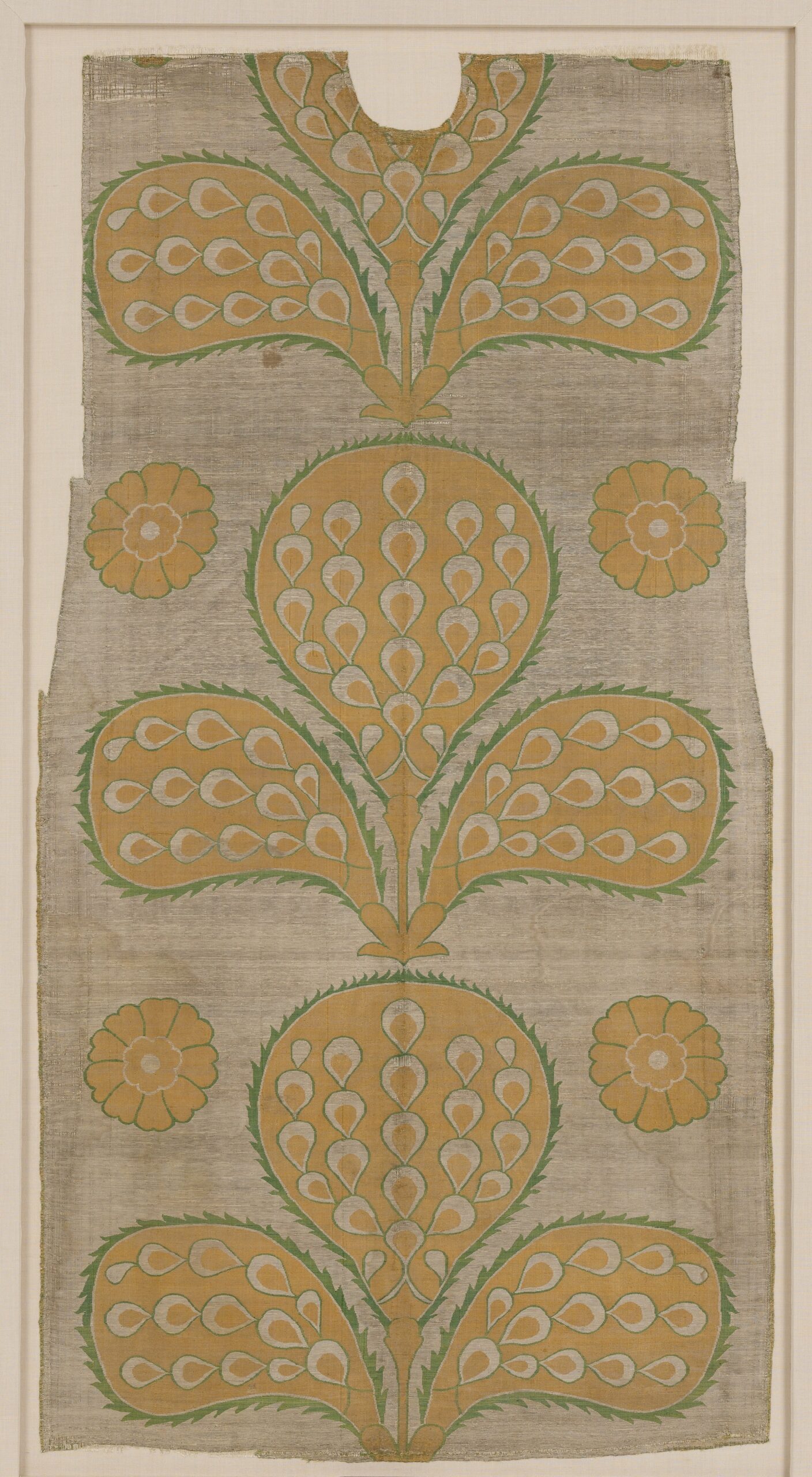
The object is a fragment of the back of a Kaftan. A Kaftan is a type of robe that was made out of wool, cashmere, cotton, or silk that covers the full body and was usually worn by men. This piece of clothing is believed to have originally been created in central Asia and/or Mesopotamia before spreading across Eurasia in 1000 CE. Certain areas, such as Persia and Byzantium, would be seen as foreign luxury attire and were traded on the Silk Road. This Kaftan is made out of Silk and is considered a taqueté/seraser which is a textile technique with the former from France and the ladder from the Turkey/Ottoman Empire that uses metal-wrapped silk to bind the textile and is quite rare.
How to use this source
- This source can be used to teach about The Ottoman Empire
- Covers 9.10e
- This source can be used to show how culture and wealth was seen in mid-16th century Turkey
- Covers 9.2a
- The source can be used to teach about how open trade was during this time with the materials and techniques used for this.
- Covers 10.1a
- The source can also show how the geography affected the style and creation of the piece of clothing
- Covers 9.1b
Bibliography
- “Fragment of a Kaftan Back.” The Metropolitan Museum of Art. Accessed July 19, 2024. https://www.metmuseum.org/art/collection/search/451095.
- “Kaftan.” Fashion History Timeline, March 19, 2022. https://fashionhistory.fitnyc.edu/kaftan/.
- “Cultural Selection: Chinese, Sogdian, and Byzantine Influences on Caftans Uncovered from Archaeological Sites along the Silk Roads.” The United Nations Educational, Scientific and Cultural Organization. Accessed July 27, 2024. https://en.unesco.org/silkroad/content/cultural-selection-chinese-sogdian-and-byzantine-influences-caftans-uncovered.
- “Textile Fragment.” The Metropolitan Museum of Art. Accessed July 27, 2024. https://www.metmuseum.org/art/collection/search/454609.