By Alyssa Finck
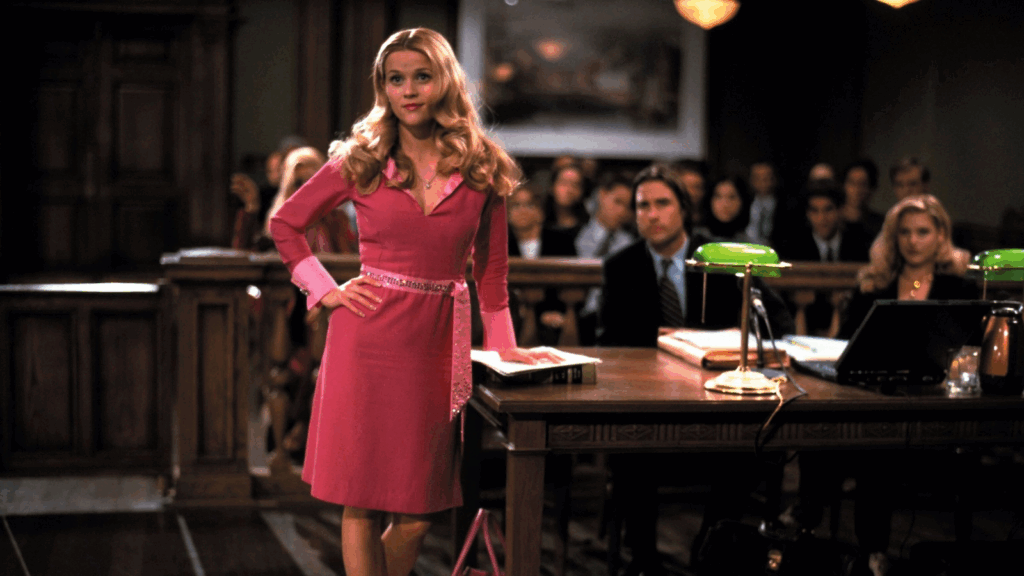
The 2001 film Legally Blonde follows Elle Woods, played by Reese Witherspoon. Elle is someone who has been underestimated her whole life because of her appearance. Elle is your go-to fashionista. Her hair is always done, she’s always in a full face of makeup, and she has a closet full of stylish outfits. However, Elle surprises everyone by gaining acceptance to Harvard Law School and succeeding as a lawyer. As such, the film challenges the “dumb blonde” stereotype: a blonde female who just based off her looks is determined to be unintelligent.
When the film was released in 2001, there was a new wave of feminist activism. As Kelly Aliano notes, in the late 1990s and early 2000s, feminist activism “focused on workplace rights, fought against sexual harassment, and aimed to amplify the voices of women from a broader range of backgrounds.” Although the film has some feminist aspects, I don’t believe it takes this idea as far as it could have. On the one hand, it focuses on workplace rights (especially a woman’s ability to succeed in the male-dominated law profession); it shows how women’s knowledge of so-called “superficial” things like beauty can actually be an asset in the courtroom; it criticizes the sexual harassment that female lawyers face; and it celebrates the power of female friendship. However, the film’s feminist message also falls short because it reinforces conventional notions of beauty, does not amplify the voices of women from diverse backgrounds, and celebrates a wealthy character who essentially buys her way into Harvard.
Throughout the film, Elle feels pressure to change her appearance and personality to fit in at Harvard. Elle’s personality is very bubbly and emotional, while the other Harvard students, like Vivienne, are more serious and reserved. You can see the comparison of the two in the movie. When Elle is on the screen she is always in a fun, colorful (usually pink) outfit. But the Harvard Law students are depicted in a much different way. The males are shown wearing very muted colors and lots of button-downs, sweater vests, and blazers. The female students also wear very muted and neutral colors and lots of blouses and cardigans, things we would never see Elle wear. So when you first see Elle Woods appear on your screen, you might think “No way she gets into Harvard,” but oh does she prove you wrong.
Although the movie doesn’t entirely go as deep as it can into the feminist aspects of the issues Elle is facing it still depicts a woman succeeding in the male-dominated field of law.
Sarah Thomas, a managing partner at a successful law firm, says that in 2023, “the ratio of male to female lawyers is still far from balanced. Men continue to outnumber women in the legal industry 61.5% to 38.3%.” When Elle’s ex-boyfriend Warner is surprised that she is accepted into Harvard Law School, Elle herself says, “What, like it’s hard?” Here, Elle is showing her confidence and acting like it was not a big deal. When I hear this line, I also think of a line I hear a lot of people around me say, which is “I don’t need a man.” This quote is said by a few of my favorite YouTubers as well as my friends. I hear them say it most often when they are completing a task that a man would be very helpful for, but they know they can do it themselves. For example, one of the YouTubers filmed herself hanging a pretty big picture frame by herself, and after she showed her struggles, but then finally hung it successfully, she said, “And that’s why I don’t need a man.” This line relates to the message of Legally Blonde because it gives women the idea that they can do anything men can do. By seeing Elle succeeding, it gives young girls the same hopes and dreams that they, too, can succeed at something, even if it’s a profession or task that is often performed by men
Not only does the film show a woman succeeding, but it also demonstrates how Elle’s knowledge of hair, makeup, beauty, and fashion can actually be an asset in the courtroom. When you see Elle, her hair and makeup are always done to the max, and she is almost always in a pink sparkly outfit. In the film, Elle is told she needs to change her appearance and personality to fit into law school and into the male-dominated field. To fit in, she would completely have to change the person she is, and Elle is not someone to change just because someone told her to. Many of the characters have a sexist mindset and believe that Elle can’t be successful because of how she looks and acts. However, she proves that just because she’s a female who loves all things beauty and fashion, she can still achieve her dreams and be successful. We see this in the film when Elle is on a case defending a fitness instructor, Brooke, who is accused of murdering her husband. Brooke’s stepdaughter, Chutney, takes the stand, explaining she couldn’t possibly have been the murderer because she was in the shower at the time the crime took place. But when Elle questions Chutney and learns that she had gotten a fresh perm earlier that day, Elle realizes that Chutney is lying because you’re not supposed to shower until at least 24 hours after a perm. Drawing on her knowledge of beauty, she solves the case and proves that Chutney was the murderer. This just shows that Elle being different from the typical Harvard Law students helped her and showed everyone that she too can be successful. In a male-dominated profession, Elle uses her determination, knowledge, and confidence to challenge them and shows the world that you do not need to conform in order to succeed.
Another feminist aspect of the film is its depiction of competitive female relationships that then become powerful friendships. When Elle and her ex-boyfriend’s new fiancée, Vivienne, meet, they don’t initially hit it off. Vivienne initially had the same thoughts as everyone else: “How did she get into Harvard?” But as the movie progresses and Elle shows her skills in the courtroom, Vivienne starts to respect her and realizes that she misjudged Elle. While the two initially competed for Warner’s attention, at the end of the movie, you see Vivienne cheering on Elle during her graduation speech, symbolizing a growing female relationship. There is also Paulette, the manicurist. Elle and Paulette form a great bond where they both help each other. Elle helps Paulette gain the courage to stand up to her ex, and Paulette is there for Elle to keep pushing her through law school and cheering her on.
While the film challenges patriarchal ideas by focusing on a woman’s success in a male-dominated profession and highlighting the power of female friendship (rather than competition), it also takes a problematic view towards beauty standards. Its main character loves all things pink, fashion, and sparkles: things people stereotypically associate with conventional femininity. In the film’s poster, Reese Witherspoon is dressed in a pink dress with the words “Legally Blonde” written in bright pink behind her. Witherspoon is conventionally beautiful: she is thin, blonde, and wealthy. In the film, a lot of Elle’s successes are based on her physical appearance. For example, when Elle applies to Harvard. Though she did have one of the highest LSAT scores, she sets herself apart from the other applicants by submitting a video essay, which shows off both her wealth (she is in a very nice house with a pool and hot tub) and her body (in the video, she wears a bikini). Elle also uses her appearance to gain connections. She does this by using her appearance to gain people’s friendships and build rapport in both social and educational circles. She can win over many people in the film because of her appearance and charisma. Another issue with the film is that the cast is predominantly white, excluding the experiences of people but especially women of color. Thus, the film does not make it a point to prove that you do not need to be white, wealthy, or stereotypically beautiful in order to have success.
While Legally Blonde created meaningful feminist moments that can empower young women and show them their worth, it’s also important to recognize the potentially harmful messages it may send to women who don’t see themselves being represented in the film because they are not skinny, blonde, and wealthy.
Works Cited
Aliano, Kelly. “The Information Age, 1991-2001.” Women & the American Story, wams.nyhistory.org/end-of-the-twentieth-century/the-information-age/.
Legally Blonde. Directed by Robert Luketic, Metro-Goldwyn-Mayer Studios Inc., 2001.
Thomas, Sarah. “Creating Space at the Table: Succeeding as a Female in the Still-Male-Dominated Field of Law.” ABA Journal, 29 June 2023, www.abajournal.com/voice/article/lowering-the-ladder-succeeding-as-a-female-in-the-still-male-dominated-field-of-law.
Alyssa Finck graduated from The State University of New York at Cortland in May of 2025 with an Inclusive Education degree. While at college they were a co-creator of the SUNY Cortland online journal Emblaze. She is currently getting her Master’s degree in School Counseling and is working on finding a full-time teaching position.