
Are we judging our political leaders by what they stand for or what they believe?
We’re quick to pride ourselves on America’s commitment to freedom and religious tolerance, but apparently that commitment has its limits when a Muslim American steps into the political spotlight. The reaction to Abdul El-Sayed and his Muslim identity has raised a question that should be embarrassing for a country founded on religious freedom: when is a Muslim identity a disqualification for being American?
To be clear, this isn’t an argument that everyone should agree with El-Sayed or should have voted for him, because that decision is entirely up to each individual. Nevertheless, we should absolutely scrutinize the political figures that want to represent us. A politician’s policies, qualifications, values, and actual ability to serve our nation are fair subjects of criticism and debate. What shouldn’t be up for debate, however, is whether someone deserves the opportunity to participate in American democracy because they practice a different religion or culture. Unfortunately, some of the reactions online go far beyond political disagreement, and it’s made scrolling through social media pretty insufferable.
I want to provide a few examples I’ve gathered from a sea of posts that reveal just how normalized anti-Muslim prejudice has become, in hopes that we can learn from one another and stop spreading these harmful narratives. I want to break down what these arguments are actually saying so we can see the flaws in their logic and view their claims as exaggerated theatrics.
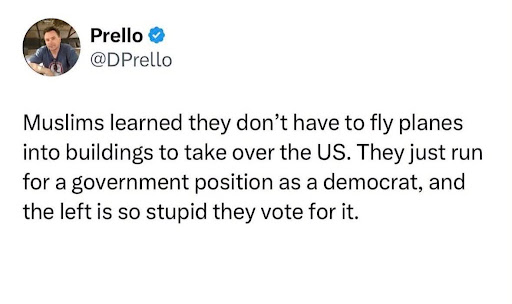
This ridiculous argument compares a Muslim American running for public office to the September 11th terrorist attacks. It assumes that being Muslim automatically makes someone dangerous and disloyal to our country. It should be clear to every American that the horrific terrorist attacks carried out by Al-Qaeda are not representative of every Muslim in the world and those who run for public office, just as the actions of extremists from any other religion do not represent everyone who practices that faith.
What’s even more disturbing to me is that this post insinuates Muslim-Americans have found a different way to attack the country, rather than acknowledging that political participation is a basic democratic right. Let’s think about what that implies about how they view their fellow Americans. There are many people like this poster who think a Muslim citizen can’t run for office or receive votes without having their intentions questioned.
It’s ironic to accuse someone of threatening American freedom when they’re doing exactly what American freedom allows them to. If your idea of protecting this country involves questioning whether an American citizen should be allowed to run for office because of their religion, maybe you should reconsider what exactly you think you’re protecting.

This post also misses the mark completely. First, Islam is a religion, not the Iranian government. You can’t look at the actions of a foreign government and automatically blame every person who practices the religion associated with that country. Again, that would be like assuming every American Christian is responsible for every action taken by Christian-led government. A Muslim candidate does not become the embodiment of Islam, just as a Christian candidate does not represent every Christian in America.
While you can disagree with the Iranian government, it makes no sense to hold an American citizen, born in Michigan, responsible for the actions taken by a foreign government due to their religious commonality. If people are unable to separate those two things, they might want to reconsider making political arguments online.
What both of these posts share is that neither one actually discusses El-Sayed’s policies or his ability to represent us. Instead, they’ve already decided that his religion is enough to make him suspicious, even a threat to America. That’s the problem. When someone’s faith becomes the entire basis of an argument against them, it says a lot more about the person making the argument than it does about the candidate.
Another concern that seems to come up is the idea that a Muslim politician will somehow force Sharia law onto Americans. But where is the evidence that El-Sayed intends to do that? If people would put the same time into Googling this rather than spreading misinformation, they’d find that this isn’t his intention at all. In fact, he has asserted his commitment to the U.S. Constitution and supports the separation of church and state. For those who are unaware, being Muslim doesn’t mean someone wants to impose Islamic law on everyone, just as being Christian does not automatically mean someone wants biblical law to govern the country.
I want to clarify why I’m bringing Christianity into this discussion so frequently. Christianity is the largest religious affiliation in the United States, and many of the posts I’ve encountered promoting these views appear to come from people who identify with the Christian faith.
I’ve come across countless posts where people seem perfectly comfortable with Christian beliefs influencing American politics, yet when a Muslim candidate enters the conversation, suddenly there’s a major concern about keeping religion out of government. You can’t expect Muslims to separate their faith from politics while also defending the influence of Christian beliefs in the same space. If the argument is that religion shouldn’t dictate laws for everyone, which it shouldn’t because the First Amendment forbids it, then that standard needs to apply regardless of whose religion is being discussed. I came across a post that perfectly shows this contradiction.
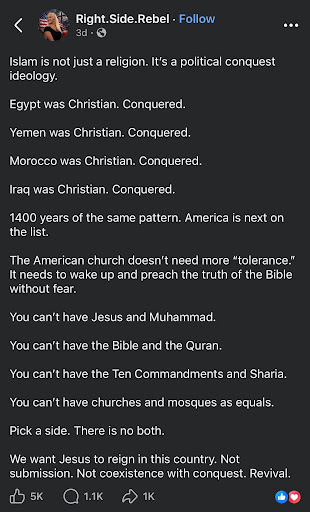
The problem with this argument is that it treats the existence of Muslims as evidence of some larger plan to conquer America. It also takes complicated histories and reduces them to an entire religion as a threat. And apparently, allowing someone to practice Islam peacefully is now considered surrendering to it. What’s scary to me is the claim that churches and mosques shouldn’t be considered equals. Why? Someone else’s freedom to worship doesn’t take away yours. A Christian can believe in Jesus without denying a Muslim the right to practice Islam. Respecting another person’s religious freedom does not mean abandoning your own beliefs.
And if the message is supposed to be about following Jesus, then maybe the teachings of Jesus need to be revisited by people who back this narrative and share it. Wasn’t compassion and loving thy neighbor supposed to be a central part of Christianity? It’s hard to understand how someone can say they represent those values while arguing that an entire religious group should not be accepted as equals in the country they call home. I say this while not criticizing Christianity, instead the use of it as justification for excluding other people.
Aside from these heavily flawed arguments that encourage harmful biases towards other Americans, the bigger issue is that this outrage seems like such a misplaced priority. Everything is expensive. The cost of living continues to put pressure on Americans. We have political corruption, the absence of government accountability, and doubts about if the people in power are actually working for the public. We have rapid developing artificial intelligence that raises serious questions about jobs, privacy, and even the future of humanity. There are so many things worth paying attention to. Yet somehow, a Muslim American who has just been elected to represent Michigan in the United States Senate has become the issue that has grabbed so much attention. And for many of these people, the concern seems to have very little to do with his policies or how he intends to represent the American people.
We have to ask ourselves why we’re spending so much time questioning whether a Muslim American belongs in government instead of questioning what the people already in government are doing. Why are we so quick to overlook the very freedoms our Constitution protects? Why do we seem to believe that those freedoms only apply to people whose religion we agree with?
You don’t have to vote for Abdul El-Sayed. You don’t have to agree with him. But if your biggest argument against him is that he’s Muslim, then maybe it’s time to ask yourself why that bothers you so much. Because if we claim to value our freedoms and democracy, we can’t just abandon those values when the person exercising them doesn’t look or believe the way we do.