
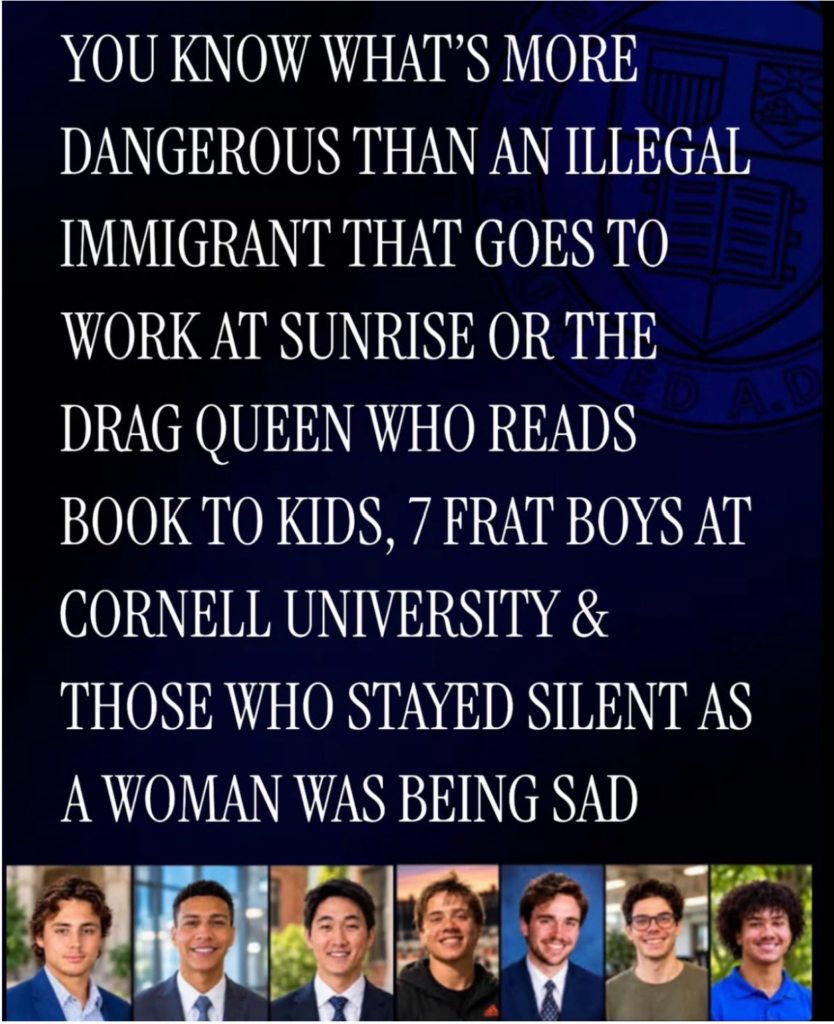
“You know what’s more dangerous than an illegal immigrant that goes to work at sunrise or the drag queen who reads books to kids, 7 frat boys at Cornell University & those who stayed silent as a woman was being SA’d.”
That post, and others like it, showed up all over my Instagram feed after a former Cornell student filed a civil lawsuit alleging that seven members of the Chi Phi fraternity drugged and sexually assaulted her in 2024. Some versions swapped in a transgender athlete. Others used a drag queen reading books to children. Every post with this wording used hardworking immigrants. Every version used the Jane Doe case as the punchline.
I understand what these posts are going for. The people making and reposting them want to point out what they see as misplaced fear aimed at immigrants, transgender people, and drag performers, while sexual violence gets far less attention, and it’s a fair thing to want to talk about.
However, we need to ask ourselves what any of those groups have to do with what happened to Jane Doe.
A woman alleges she was drugged and assaulted at a fraternity house, and that allegation deserves attention on its own. When her case becomes the setup for a line about unrelated political discourse, the conversation moves away from holding these men and Cornell’s systemic failure accountable. Her experience shouldn’t have to prove a point about immigration or include anything about transgender athletes to matter, vise versa. The Cornell 7 case matters because there is a woman who says she was harmed. It matters because there are allegedly men inflicting sexual violence. It matters because there is an academic institution that made a woman pay to leave a place where she no longer felt safe.
Most people sharing and reposting these posts mean well, but good intentions still don’t make every claim fair. When advocacy turns into a controversial comparison, people who might have listened may see the performance instead of the principle. Placing seven fraternity members accused of assault with immigrants, transgender people, and drag queens is such a bizarre leap that the comparison is easy to dismiss. And when an argument is easy to dismiss, the case attached to it risks being dismissed too. Critics get an easy reason to dismiss the whole argument as opportunistic, and the people these posts want to defend end up worse off. A few infographics don’t speak for an entire movement, but we are responsible for how we argue for the things we believe in. That includes calling out claims from people on our own side.
Which brings me to my next point. When people questioned the relevance of these issues to what happened to Jane Doe, or even mentioned that all crime should be punished, they were met with unreasonable hostility. That reaction shuts down the very conversation these posts claim to want. It’s a fair question, and the people who are genuinely asking it are entitled to an answer free of discourtesy or belittling.

As a collective, we have to be more open-minded with each other and accept that not every subject is black and white. A person can want these men held accountable and still think comparing them to immigrants misses the point, and a person can support transgender rights and still ask why a trans athlete is in a post about the Cornell 7 case. When we treat every question as proof that someone is on the other side, people stop asking questions altogether. The conversation becomes about choosing a team, and we stray further from understanding each other and making real change. And what happened to Jane Doe, the reason any of us were talking in the first place, is no longer the center of the conversation.
We can defend marginalized groups without using a woman’s alleged sexual abuse as an example. Those causes are strong enough to stand on their own. What happened to Jane Doe deserves to be taken seriously without her case becoming someone else’s talking point and the way we argue for our values matters as much as the values themselves.