
Written by Jamie Cuozzo and Caitlyn Dorman
Lauren Giangrasso was a rookie officer in September 2001. She was freshly out of the academy, on active duty and ready to work and serve as a New York City Police Officer. Giangrasso’s neice, Jamie Cuozzo, is a SUNY Cortland student and co-author of this article.
At the time of the attacks, Giangrasso was sleeping at home on Long Island due to her hours being 5:30 PM to 2:05 AM. When she woke up, she heard about the attacks through the news. As she watched the events unfold, she was shocked and confused but the main thing on her mind was that she knew that she needed to get to work as soon as possible. She knew she was going to have to get up and pack a bag with the unknown mindset about what she was walking into or if she would see her family again.
“I woke up and I had a conversation with my mother and she was like, ‘you’re going to wind up going into work early,’ and while we were talking, our home phone rang and they called from my precinct saying that everybody had to report to their command, which just means, you know, come on in,” said Giangrasso.
Giangrasso got dressed in uniform and reported to her precinct located in Forest Hills. Although her precinct was not in the area directly affected by the attacks, the events of 9/11 had a profound impact on the greater New York State region, even if not in a physical sense.
“I went from a rookie police officer to a veteran, like overnight,” said Giangrasso. “I had to do what I had to do. That was it.”
The events of 9/11 never made her second-guess her decision to become an officer.
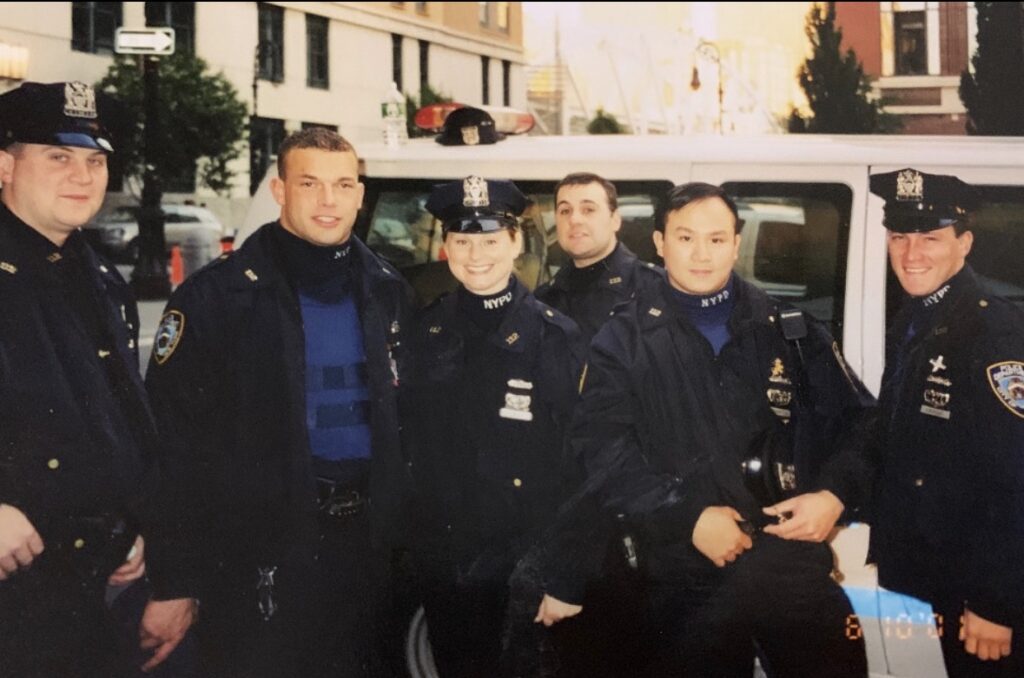
At the time of the attacks, a police academy class was still in session, and those recruits were brought out to assist on the streets. Since they weren’t officially sworn in yet, they couldn’t carry firearms, but extra hands were desperately needed, so they were pulled from the academy to help wherever they could.
“So basically, since we were on an outside command working in, my command was in Queens, they had us be posted outside of the World Trade Center site. So each day was a little bit different,” explained Giangrasso.“Technically, we were like security posts just watching who entered and exited the area because they still didn’t really know what was happening. We were on 12-hour tours and we were just watching who was entering these sites and if they had proper credentials. I was not part of the cleanup. I was just on the outskirts working security.”
Giangrasso says it often felt like she had to put blinders on and do whatever was asked of her, focusing on her duty and the people she served.
“At first, I really wanted to help out as best as I could. And I didn’t know what it looked like from the start. But since I was just working day in and day out, I just didn’t have time to even volunteer to help with the cleanup in the pit,” added Giangrasso. “In a sense, I kind of lucked out being on a security post because I wasn’t in that pit area and breathing in whatever toxic substances were in the air because I know a lot of folks that were working there, they got sick. And sadly, many have passed away from 9/11-related injuries and illnesses.”
During such a dark time, the communities across all five boroughs came together to support one another. Giangrasso explained that it was incredible to see the outpouring of support, whether in Forest Hills, where she was stationed, or when she drove into New York City. Everywhere she went, there were people holding signs that read “Thank you NYPD” or “Thank you FDNY.”
“Most of those local businesses were shut down for quite a long time. Anyone that was able to operate, were very generous and they opened up their doors, and they would supply food and water to anyone that was volunteering or working,” said Giangrasso. “The churches and the mosques were all on high alert for quite along time because a lot of those places were targeted.”
Giangrasso recalled how the city truly came together for quite some time, with people from outside agencies coming in to help wherever they could. Lauren remembered chaplains driving around to visit officers at their posts, checking on them and praying over them. Volunteers came from as far away as Ohio and New Orleans, offering their time and support to help in any way possible during such a terrible situation. She deeply appreciated the amount of gratitude and respect the police department received, something she notes has become rare in more recent times.
Giangrasso explained that nothing else in her twenty years as a NYPD officer has ever made her feel the way she did during 9/11. No other experience came close to the emotions and intensity of that day.
She explained that it is difficult for her to watch the memorials or see the news coverage each year on the anniversary of 9/11. She often avoids watching videos or visiting memorials because of how emotional it feels.
“I didn’t lose anyone close to me in the terrorist attacks, but there were, I believe, 23 NYPD officers that perished. I didn’t know any of them personally,” said Giangrasso. “It’s not easy to watch the memorials as they read the names of lost folks that were never found and family members that are still searching. It’s hard for me to watch that, so I usually do not. I just pray for everybody that has lost a family member or loved one. It’s hard to wrap your head around that it actually happened.”